
Over the Moon (2020)
Director: Glen Keane, John Kahrs
Screenwriter: Audrey Welles
Starring: Cathy Ang, Phillipa Soo, Ruthie Ann Miles, Robert G. Chiu, John Cho, Ken Jeong, Sandra Oh
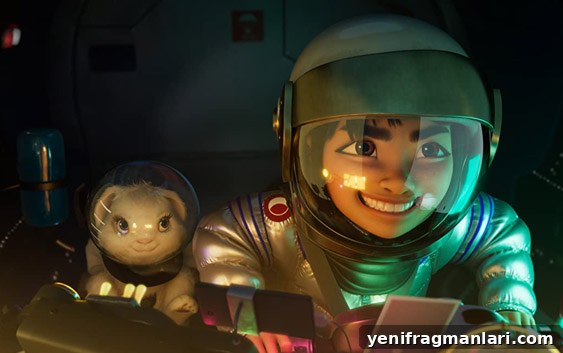
Netflix’s animated musical fantasy Over the Moon was nominated for Best Animated Feature at the 2021 Oscars. Directed by veteran animator Glen Keane alongside John Kahrs and written by Audrey Welles, the film centers on Fei Fei (Cathy Ang), a determined young girl who builds a rocket to prove the existence of the moon goddess Chang’e. Combining bright, stylized visuals with musical set pieces, the film aims to blend folklore, family grief, and childlike wonder into a modern fairy tale.
The story opens with a poignant family prologue: Fei Fei’s life is altered when her mother, Ma Ma (Ruthie Ann Miles), dies after a battle with illness. Fei Fei holds onto the folktale of Chang’e—a heartbroken goddess living on the moon—because that story was a bridge between her and her mother. Through music and a sketchbook-style animation, the film retells Chang’e’s legend and establishes the emotional core that drives Fei Fei’s actions after Ma Ma’s death.
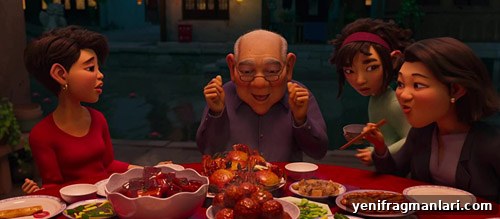
Set against the annual Moon Festival, a harvest celebration when families gather to share food and mooncakes, the film uses this cultural backdrop to show Fei Fei’s devotion to tradition. She and her father bake mooncakes for their town, a ritual that becomes a symbol of her loyalty to Ma Ma’s memory and her desire to keep family traditions alive. Glen Keane’s storytelling places these domestic scenes at the heart of the film, and they are among the most affecting moments: intimate, grounded, and emotionally convincing.
When relatives ridicule Fei Fei for believing in Chang’e, she channels her scientific curiosity and determination into building a rocket to reach the moon. On her journey she discovers Chin (Robert G. Chiu), a stowaway whose optimism and comic timing provide a buoyant counterpoint to Fei Fei’s grief. Chin’s relentless cheerfulness lightens some of the film’s heavier moments and helps Fei Fei learn that change can open unexpected possibilities.
Once on the moon, Fei Fei and Chin find that Chang’e (Phillipa Soo) is not the sorrowful spirit of the folktale but a celebrity pop star adored by her lunar subjects. The film stages a spectacular, Eurovision-style performance with elaborate costumes, pyrotechnics, and catchy songs—an upbeat sequence that showcases the film’s musical ambitions. Fei Fei must then run a gauntlet of tasks to return a lost gift to Chang’e, motivated by a simple, modern desire: photographic proof to validate the myth for her family.
The narrative occasionally struggles under the weight of its own invention. New characters and subplots arrive frequently, which fragments narrative focus and dilutes the film’s emotional arc. While the home-based scenes and Fei Fei’s personal journey feel well-drawn, the moon-bound sequences sometimes prioritize spectacle over depth. The middle section, in particular, suffers from a drop in narrative momentum and a noticeable shift in animation quality that can feel uneven compared with the film’s strongest moments.
Visually, Over the Moon mixes styles. The sketchbook sequences and hand-drawn flourishes emphasize tradition and storytelling, recalling the folktale roots of the Chang’e myth. In contrast, the moon’s environments favor bold block shapes, saturated colors, and smooth surfaces designed to appeal to children. This variety keeps the film visually engaging but also contributes to the inconsistent tone; the juxtaposition of folk-inspired textures and hypermodern pop aesthetics occasionally clashes.
The voice cast delivers warm, energetic performances. Cathy Ang anchors the film with a clear emotional throughline as Fei Fei, while Phillipa Soo gives Chang’e an effervescent, performative presence that fits the character’s pop-star incarnation. Supporting voices—including John Cho, Ken Jeong, and Sandra Oh—add color and charm to the extended family and lunar ensemble, helping the film remain accessible and lively for younger viewers.
The film’s themes—grief, tradition, ambition, and the importance of family—are relevant and handled with sincerity. Songs are memorable and likely to linger with young audiences, and the movie offers numerous teachable moments about resilience and letting go. Yet despite its warmth and visual creativity, Over the Moon does not always achieve the narrative cohesion or emotional weight of some peer animated features. It is nevertheless a heartfelt, family-friendly picture that showcases Glen Keane’s return to feature animation and introduces a culturally specific folktale to a wide audience.
12/24