
Priscilla (2023)
Director: Sofia Coppola
Screenwriter: Sofia Coppola
Starring: Cailee Spaeny, Jacob Elordi, Ari Cohen, Dagmara Dominczyk
Following Baz Luhrmann’s flamboyant depiction of Elvis, Sofia Coppola took on a very different challenge: adapting Priscilla Presley’s memoir into a film that re-centers the story around her perspective. Where Luhrmann’s Elvis was a spectacle of excess and mythmaking, Coppola’s Priscilla strips that glamour away and asks us to see the relationship and its consequences through the narrower, more intimate lens of the woman who lived beside the King.
The film opens like a youthful romance: Priscilla (played by Cailee Spaeny) is a fourteen-year-old girl in West Germany who, with her parents’ hesitant permission, attends a party at the house Elvis (Jacob Elordi) is renting. The initial meeting reads like a chapter of teenage fantasy—an instant and intense connection that feels as much about shared loneliness as it does about attraction. Elvis becomes the gravitational center of Priscilla’s world; he tells her father he simply enjoys talking to her, and their early courtship is tender, private, and seemingly protective against the loneliness they both feel.
But that bubble bursts when Elvis’s military service ends and he returns to the United States. Priscilla follows him to America after convincing her parents to allow her to finish high school there. Memphis offers glamour and proximity to a global superstar, yet the reality of living with Elvis at Graceland is far different from the idealized romance she imagined. What began as adoration gradually reveals darker patterns: controlling behavior, rigid expectations about how she should look and behave, and emotional manipulation that isolates Priscilla rather than shields her.
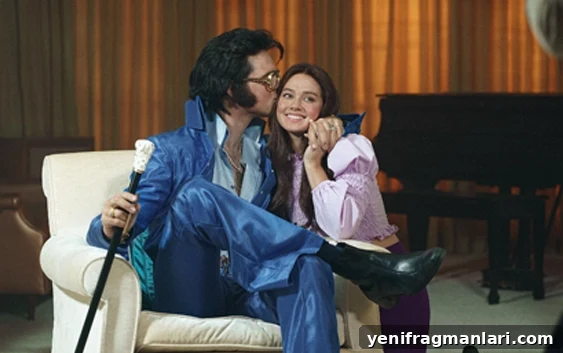
Coppola’s narrative choice is deliberate: the film keeps Elvis at the margins of his own myth and instead focuses on how his celebrity presence shapes and constrains Priscilla’s life. Jacob Elordi’s portrayal leans away from performative imitation and toward quietness, emphasizing the private man rather than the public icon. This muted depiction serves Coppola’s aim to return agency and voice to Priscilla, showing that beneath the public persona there were real, often troubling interpersonal dynamics. The film does not whitewash Elvis’s actions; rather, it exposes moments of possessiveness, temper, and emotional coercion.

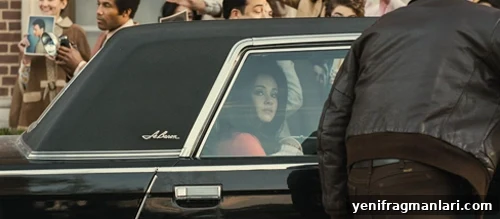
Visually, Priscilla bears Sofia Coppola’s unmistakable signature. Every frame is carefully composed, and the production design is obsessed with detail: costumes, furniture, cars, and small personal items are all chosen to create a palpable sense of time and mood. Graceland is rendered as both sumptuous and confining—an environment designed to shelter and display at once, but which ultimately contains and diminishes Priscilla’s freedom. Cinematographer Philippe Le Sourd often frames the action tightly on Priscilla, creating a feeling of claustrophobia even within opulence. The result is an environment that feels authentic and tactile while continually emphasizing Priscilla’s isolation as Elvis’s world pulls away.
Cailee Spaeny’s performance is a central strength of the film. Casting a relatively fresh face allows the audience to encounter Priscilla as a person rather than as a cultural shorthand. Spaeny conveys an evolving interior life: innocence and infatuation give way to confusion, entrapment, and a search for self. The film also highlights the age difference and power imbalance at the core of their relationship. While the romance is often depicted with tenderness, Coppola carefully avoids glamorizing the imbalance. The physical and emotional consequences of that imbalance—Priscilla’s curtailed autonomy, her role as an object of protection and possessiveness—are made clear without melodrama.
Hair and appearance function as recurring motifs that illustrate Priscilla’s transformation. Early on, her restrained hairstyles symbolize youth and control; later, changes in hair color and styling mark shifts in identity and autonomy, signaling how much of her image is shaped by others’ expectations. Coppola uses these visual cues to explore how womanhood and selfhood are negotiated, sometimes surrendered, and sometimes reclaimed.
Priscilla sits firmly within Sofia Coppola’s body of work, continuing her interest in the interior lives of women and the often-overlooked consequences of fame. The film asks viewers to reconsider familiar narratives by centering a perspective that has long been sidelined. It is not an exposé seeking to rewrite history; rather, it is a measured, intimate portrait that invites empathy and reflection. By prioritizing Priscilla’s experience, Coppola encourages us to see her as a complex individual whose story deserves attention on its own terms.
Score: 19/24
Rating: 4 out of 5.