


Taxi Driver (1976)
Director: Martin Scorsese
Screenwriter: Paul Schrader
Starring: Robert De Niro, Jodie Foster, Cybill Shepherd, Albert Brooks, Harvey Keitel
On a sultry New York night, a cab glides into view and the camera fixes on a face lit by neon—the opening sequence of Martin Scorsese’s Taxi Driver is an unforgettable portrait of a city and a mind. Emerging from the American New Wave of the 1970s, the film blends arthouse ambition with mainstream cinematic energy. It is a neo-noir crime drama that transcends being merely a star vehicle for Robert De Niro: it is a complex study of loneliness, rage, and urban decay that remains resonant decades after its release.
This was Scorsese’s second major collaboration with Robert De Niro and helped cement both men as central figures of the “auteur generation” of American filmmakers. By 1976 Scorsese had already directed films that showed his range and sensibility, but Taxi Driver elevated his reputation internationally, earning top festival honors and multiple award nominations. Paul Schrader’s screenplay provides a raw, intimate portrait of a disturbed mind, and Scorsese’s direction and Bernard Herrmann’s final score shape it into a powerful cinematic experience.
The film follows Travis Bickle, a Vietnam veteran turned night-shift taxi driver. Sleep-deprived and increasingly detached from the social world around him, Travis drifts between voyeurism, fantasy and mounting hostility. His attempts at human connection—awkward encounters with Betsy, a campaign worker, and strained conversations with fellow cab drivers—only deepen his isolation. Travis keeps a journal where his fractured inner monologue unfolds: at times sympathetic, often disturbing, it exposes a worldview steeped in contempt and paranoia.
Travis’s relationship with Iris, a young sex worker, becomes the moral and emotional fulcrum of the film. Jodie Foster’s performance as Iris is striking for its naturalism and bravery; she brings a teenager’s resilience and vulnerability to a role that required careful handling. The scenes between De Niro and Foster pulse with uneasy tenderness, offering a counterpoint to Travis’s mounting violent fantasies. His desire to “save” Iris becomes the catalyst for the film’s bloody climax, raising difficult questions about heroism, obsession, and paternalism.
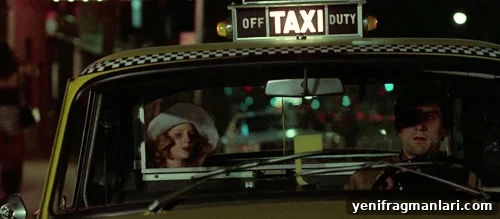
De Niro’s portrayal of Travis is layered and unsettling. Known for a natural charisma, he deliberately strips that away to inhabit a man who is socially inept and volatile. Small details—his mannerisms, his awkward attempts at flirting, the co-opted confidence that masks inner impotence—make Travis both repellent and pitiable. Scorsese’s willingness to allow improvisation enhances the performance: the infamous mirror scene, in which Travis rehearses confrontation, captures the actor’s instinctive creation of character more than any scripted moment.
Supporting performances enrich the film’s texture. Cybill Shepherd’s Betsy represents a potential normalcy Travis cannot sustain; her reactions illuminate his inability to relate. Harvey Keitel appears in a vivid, brief role that adds menace and authenticity to the milieu. Collectively, the cast brings credibility to a world of late-night bars, campaign offices, porno cinemas and city streets that feel claustrophobic and corrosive.
Stylistically, Taxi Driver is a synthesis of cinematic influences: echoes of classic Westerns in the lone-hero quest, psychological parallels to Hitchcock’s character studies, and an aesthetic debt to European art cinema. The film’s violence—graphic, immediate and unflinching—borrowed a new level of intimacy for American screen violence of the era. Special-effects work and makeup contribute disturbing physical details that make the film’s confrontations viscerally effective.
Bernard Herrmann’s score, his last, is central to the film’s atmosphere. A blend of jazz-inflected themes and brooding orchestral passages, the music intensifies the nocturnal neuroticism of Travis’s world and underscores the climactic violence with tragic grandeur. Herrmann’s score helps push the film toward a dreamlike ambiguity in its final moments, leaving open the question of reality versus fantasy in Travis’s descent.
Viewed today, Taxi Driver raises difficult debates. The protagonist’s hateful, racist diatribes and violent impulses are morally repugnant, and the film does not celebrate them. Instead, it functions as an indictment of cultural and structural failures that allow certain men to become isolated and dangerous. It does not offer simple solutions, but it forces viewers to confront how alienation, toxic notions of masculinity and societal neglect can intersect with violence.
While later Scorsese works such as Goodfellas and Casino brought him additional acclaim, Taxi Driver remains a cornerstone in both his career and Robert De Niro’s body of work. Its themes of loneliness, dislocation and violent fantasy, combined with its stylistic boldness, secure its place as an essential film from the American New Wave and a landmark of modern cinema.
Score: 21/24
Rating: 4 out of 5.
Recommended reading: Where to Start with Martin Scorsese