
Enfant Terrible (2021)
Director: Oskar Roehler
Screenwriters: Klaus Richter, Oskar Roehler
Starring: Oliver Masucci, Hary Prinz, Katja Riemann, Felix Hellmann, Anton Rattinger, Erdal Yildiz, Markus Hering, Michael Klammer
Many mainstream biopics take a glossy, Hollywood approach to larger-than-life figures, smoothing edges and amplifying spectacle to shape familiar myths. In contrast, Oskar Roehler’s Enfant Terrible resists that temptation. This is an art-house portrait for an art-house provocateur: a film that deliberately scrapes away glamour and theatricalizes its subject to examine the chaotic, often cruel genius of Rainer Werner Fassbinder.
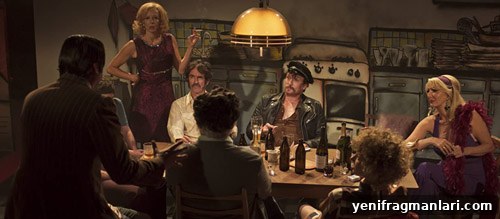
The production choice to shoot virtually every scene on sound stages is one of the film’s most striking decisions. Sets are deliberately artificial—appliances, doors and household objects are suggested rather than fully realized, often painted or flattened against the walls. That theatrical artifice mirrors Fassbinder’s own early career in theatre and television and forces attention back to the actors and their interactions. It strips away the illusion of cinematic realism so the audience must confront the characters and the dynamics on display.
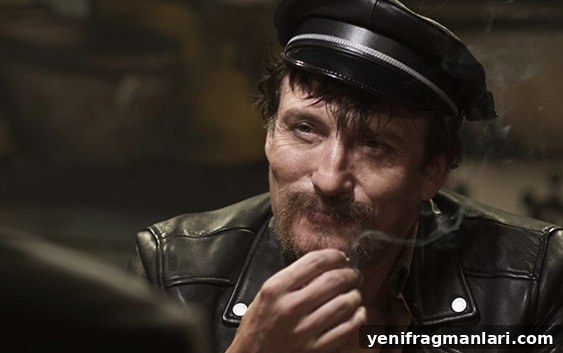
Oliver Masucci’s performance is central to the film’s impact. He embodies Fassbinder as a volatile, controlling force—someone who imposes his will on collaborators, lovers and enemies alike. Masucci’s take is relentless: he never lets the viewer settle into sympathy or simple condemnation. Instead, his Fassbinder is magnetic and infuriating in equal measure, a presence that dominates every frame he occupies. The actor’s commitment anchors the film’s harsher choices and gives the narrative a brutal, human energy.
Visually, Enfant Terrible is drenched in neon and saturated color, but this is not the sleek neon of high-budget sci-fi; it’s grimy, corrosive light that feels as though it leaks from the characters’ moods. The cinematography refuses the safety of conventional establishing shots, opting instead for compressed, claustrophobic framings that keep us inside Fassbinder’s world. The effect is disorienting on purpose: the film wants you to feel as though there is no escape from the director’s orbit.
Tonally, Roehler’s film is uncompromising. It hurtles through more than a decade of Fassbinder’s life with a feverish energy, packing enormous amounts of action, production, sex and conflict into a relatively short runtime. At times this pace feels almost breathless, teetering between purposeful compression and narrative overload. The result is a portrait that assaults the senses—an experience that can feel exhilarating and exhausting in equal measure.
One of the film’s risks is that it can seem as unfeeling as its subject. By moving briskly from triumph to humiliation, exhilaration to cruelty, the film sometimes struggles to articulate a clear moral stance toward Fassbinder. Is this a celebration of his brilliance, an indictment of his behavior, or simply an attempt to reflect his contradictions? Roehler seems content to let Fassbinder’s mercurial nature defy easy categorization, which leaves the viewer to reckon with the discomfort of admiring talent that is intertwined with destructiveness.
Supporting performances and production design contribute to the film’s uncompromising portrait. The ensemble cast plays as if propelled by Masucci’s magnetic center, their interactions often edged with tension and unpredictability. Sound design and editing keep the pace urgent, and the theatrical sets create a sense of staged inevitability—as if these moments were always meant to be observed under a harsh spotlight.
In the end, Enfant Terrible is a demanding film that rewards viewers who are willing to be unsettled. It is not a conventional biopic that smooths complexity into a tidy narrative; instead, it embraces contradiction and discomfort as a way to probe the life of a singular, difficult artist. For those open to its stylized methods, the film offers a powerful, if uneven, meditation on creativity, control and the cost of genius.
18/24