
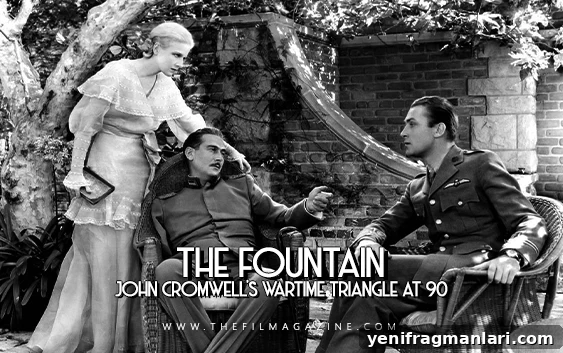
A man and a woman meet in wartime; their brief love creates a suspended moment amid devastation. She is married, and the affair is contained largely within a single piece of music. This film is not Casablanca.
The Fountain premiered on 23 August 1934 and received praise for its fidelity to Charles Langbridge Morgan’s novel, though some critics worried about its slow, contemplative pace. Ann Harding, the film’s star, confessed, “Maybe we should never have made it,” yet she and director John Cromwell defended the picture. They insisted on remaining true to the book rather than producing a Hollywoodized version: “We had to do the book and not a Hollywood version of it. Sam Hoffenstein wrote a poet’s script, and it was shot exactly as written.” The film’s mixed initial reception underscores how remarkable it was to find such introspective material within the studio system. Ninety years on, Cromwell’s wartime triangle still stands out for its emotional restraint and thoughtful intelligence.
The Fountain opens in relative silence, with Max Steiner’s score drifting through the carriage of a train. Cromwell’s camera moves freely, as if an extension of the characters’ inner life, following Lewis (Brian Aherne) as he observes sleeping British officers. His calm face feels at odds with the journey that will lead to his internment. Set during World War I in neutral Holland, the film is not a war movie in the conventional sense; its conflict is the human struggle to find stillness and love amid turmoil. After time in the internment camp, the officers plan a tunnel escape, but Lewis remains aloof, preferring reading and quiet contemplation. The fort represents a kind of heaven to him, a place where “time ceases to exist.” His reluctance to escape stems from a yearning for a contemplative life and a respect for his comrades rather than a desire for freedom.
Cromwell foregrounds Lewis’s search for inner calm early on. The film opens with a quote from Samuel Taylor Coleridge’s “Dejection”: “from outwards forms to win / The passion and the life, whose fountain are within.” This epigraph signals that the true drama is inward. Lewis receives a letter from Julie (Ann Harding), inviting him to spend his parole at the castle of Enkendaal with her and the Baron and Baroness van Leyden. That letter cracks the still surface of his reserve and transforms him from a passive, contemplative figure into a man of feeling.
Most of the film unfolds at the Baron’s home, making Lewis’s earlier internment life feel like a distant memory once he is reunited with Julie. The letter sequence—its slow scroll on screen—serves to show Lewis rereading and savoring Julie’s handwriting. She purposely omits her surname, a telling detail that elevates their intimacy to a spiritual plane. Cromwell translates the novel’s subtlety into film: Lewis repeatedly writes her name on a scrap of paper later, treating it like a litany, a way to summon and sustain her presence. Julie’s offhand description of that paper as “an evergreen” captures the fragile yet enduring nature of their bond.
Cromwell introduces Ann Harding without the customary glamorous entrance. Instead, Lewis glimpses her and then retreats behind a curtain, listening as her voice floats through the scene. Keeping the camera on Lewis while letting Julie’s voice surround him emphasizes the auditory intimacy between them; her voice becomes a presence that reaches him beyond sight. When she later appears framed in a doorframe, descending a staircase, that composition visually reinforces her entrapment in the castle’s formality and her emotional difference from her family-in-law.
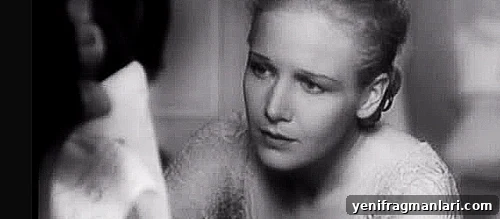
Cromwell’s soft-focus photography lends Julie an almost luminous, otherworldly presence. Hoffenstein’s script allows her to confess candidly to Lewis that she admires but does not love her husband, Rupert von Narwitz (Paul Lukas). Her language—likening herself to someone “beating against a wall in the dark, trying to find a door”—captures the desperation of a woman seeking escape from social expectation. Julie’s passionate openness contrasts with the stiff decorum of her in-laws and creates a tender, lyrical rapport with Lewis. Cromwell stages their scenes with a camera that circles and floats, turning their exchanges into a kind of waltz where words are secondary to the music and the unsaid.
By 1934 John Cromwell had begun to establish himself at RKO, directing operatic and literary adaptations and collaborating with writers who valued poetic nuance. He and Hoffenstein believed that love could not be reduced to direct declarations. The Fountain interweaves intimate dialogue with literary citations—Keats and Plato appear in moments that deepen character and meaning.
A pivotal scene finds Julie leading Lewis from the library up a hidden spiral staircase to her music room—her sanctuary. The door is initially stuck and requires both of them to pull it open, a recurring image of thresholds and the passage into intimacy. Only their joined hands and Julie’s hair are lit as they ascend; moonlight and shadow turn the staircase into a space between dream and reality. In the music room, Julie plays the piano. Music becomes the medium of their confession: she expresses what words cannot through a waltz that is Max Steiner’s love theme for the pair.
Harding’s piano performance reads like a consummation of feeling. Cromwell’s camera dissolves the scene into a dreamlike portrait of two lovers suspended in time. The following bright, almost overexposed tennis match between the British officers and Julie’s family functions as an oppositional montage, revealing Julie’s conflicted loyalties and the cold distance of her in-laws. The film carefully avoids villainizing Julie; instead it frames the triangle with compassion.
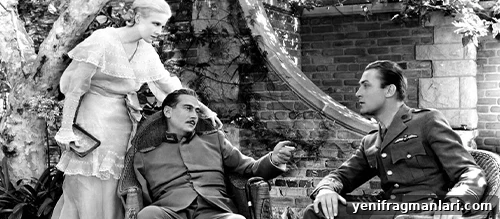
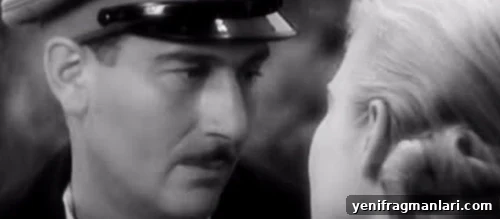
Paul Lukas’s Rupert is portrayed with dignity and philosophical yearning rather than bitter jealousy. When Rupert and Lewis meet and speak in the garden, they recognize a shared longing for contemplation—an existence beyond suffering. Their exchange, echoing Keats and Plato, frames the film’s central tension: the dream of love versus the consequences of acting on that dream. Julie embodies the possibility of peace that both men seek, yet reaching for her could destroy other truths.
Music underlines the narrative’s emotional architecture. Steiner assigns distinct themes: a tender waltz for Julie and Lewis, and a somber, harp-led motif for Julie and Rupert. The most affecting moment is when Julie plays both themes consecutively, and Rupert ascends the staircase to listen, frozen in respectful silence. That scene encapsulates the film’s restraint: unspoken longing, the power of melody to convey what language cannot, and the moral gravity of the triangle.
The Fountain remains at risk of fading from public memory. Cromwell considered it one of his favorite works, and its delicate exploration of love, duty, and inner stillness deserves continued attention. The film portrays a wartime triangle not as scandal but as intertwined human lives seeking solace. Cromwell navigates production codes with empathy, presenting illicit love with tenderness rather than condemnation. The Fountain is ultimately about the soul’s search for stillness, and it finds that pursuit in the fountains of love and passion within.
Written by Annabel Jessica Goldsmith
Sources:
W.E. Oliver, “Ann Harding to do Technicolor Versions of Sagas, Fables,” L.A. Evening Herald Express, 29/09/34.
Susan Dalton and John Davies, “An Interview with John Cromwell,” The Velvet Light Trap, Fall 1973, p. 23.
Samuel Taylor Coleridge, “Lines from a notebook – February 1807,” The Complete Poems of Samuel Taylor Coleridge, pp. 336–337.
You can support Annabel Jessica Goldsmith in the following places:
X (Twitter): @themoderns_
Research Blog: Starring Ann Harding