

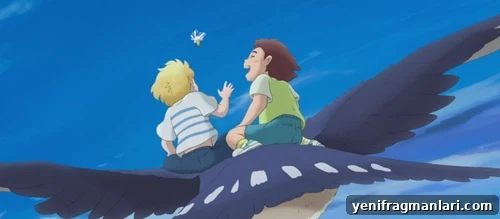
The Imaginary (2023)
Director: Yoshiyuki Momose
Screenwriter: Yoshiaki Nishimura
Starring: Kokoro Terada, Rio Suzuki, Sakura Ando, Riisa Naka, Takayuki Yamada, Atsuko Takahata, Issei Ogata
The Imaginary tells the poignant story of Rudger, an imaginary friend voiced by Kokoro Terada, who faces erasure when his real-life companion, Amanda (Rio Suzuki), falls into a coma after a tragic accident. Separated from the child who remembers him, Rudger confronts the terrifying possibility of being forgotten forever. The film follows his desperate journey to stay alive in a world where memory fuels existence.
Rudger’s search leads him to unexpected allies, including Zinzan, a majestic and amusing cat voiced by Takayuki Yamada. Together they discover a sanctuary: an old library where the imaginations contained within books sustain forgotten imaginary friends. This refuge, filled with wonder and literary energy, becomes a central and visually rich setting where childhood memories are both celebrated and endangered.
The chief antagonist, Mr Bunting (Issei Ogata), is a chilling and unforgettable villain. He appears disarmingly ordinary—baggy Hawaiian shirt, glasses—but conceals a monstrous hunger: he consumes imaginary friends to keep his own imagination alive. The film leans into horror at times, with Mr Bunting’s presence delivering genuinely unnerving moments that contrast sharply with the film’s otherwise whimsical tone. His design and actions make him one of the more grotesque animated antagonists in recent memory.
One of the film’s strongest choices is its character design. Rudger and his companion Emily are drawn as near-humanoid imaginaries among a parade of eccentric, fantastical creatures. This visual contrast helps viewers identify with Rudger and Emily emotionally, since their human-like features anchor the story’s emotional core amid a sea of imaginative oddities. That focus on relatability is an effective storytelling move: in a world of the bizarre, recognizable faces carry the film’s heart.
The Imaginary explores heavy themes—grief, fear, loss and friendship—within a colorful animated world. Stylistically, the film blends elements of Japanese anime with a simpler, more nostalgic aesthetic reminiscent of early Western animation. Backgrounds and some smaller details are intentionally understated, which adds a wistful quality and reinforces the film’s meditation on childhood memory and longing. This nostalgic undercurrent is fitting given the movie’s subject matter.
However, that same nostalgic lens can work against the film. The Imaginary often feels like a children’s story told for adults: sentimental and saccharine in ways that may not fully engage younger viewers. The narrative tone occasionally skews grown-up, and some scenes linger in melancholic reflection longer than necessary. As a result, the pacing sometimes tips toward slow and reflective rather than brisk and child-friendly.
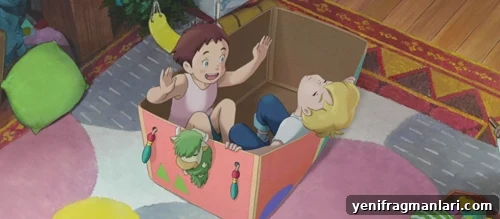
The film does not shy away from darker material: Amanda is grieving her father’s death, Rudger mourns the potential loss of Amanda, and other imaginaries vanish on screen. The unsettling tone is amplified by Mr Bunting’s eerie accomplice, an unsettling figure who evokes classic horror archetypes. For families used to animated stories that tackle difficult feelings—films where grief, fear, and loss are part of emotional growth—The Imaginary will offer meaningful, if intense, material. For others, some scenes may feel too frightening.
At times, The Imaginary struggles with balance. Certain secondary characters are overused and can become grating when given extended screentime. The film often signals emotions with exaggerated gasps and deliberate silences, as if anxious to tell viewers exactly how to feel instead of trusting their responses. Paradoxically, it both overloads the viewer with visual spectacle and moves in fits and starts, leading to moments that feel aimless or added mainly to showcase the animation rather than to advance the story.
A more fundamental issue is the repetitive rhythm of peril. Mr Bunting’s recurring attacks are relentless but rarely explained. The film offers little insight into his motives beyond the crude fact that he eats imaginaries to feed his imagination. That relentlessness reduces suspense over time: the pattern of capture and escape becomes predictable, muting emotional stakes instead of heightening them.
Because many of the creative team previously worked with famed animation studios, comparisons are inevitable. The Imaginary is not a bad film: its visual imagination, performances, and willingness to confront difficult subjects are commendable. Yet it faces stiff competition from contemporary and classic animated features that have already set a high bar. Within its own niche—stories about imaginary friends—this film stands as a respectable, thoughtful entry. It may not become a universally embraced classic, but it will likely find a devoted audience who appreciates its bittersweet approach.
Score: 15/24
Rating: 3 out of 5.