

Trap (2024) — Review
Trap (2024)
Director: M. Night Shyamalan
Screenwriter: M. Night Shyamalan
Starring: Josh Hartnett, Ariel Donoghue, Saleka Shyamalan, Alison Pill, Hayley Mills, Jonathan Langdon
M. Night Shyamalan remains one of the most recognizable contemporary studio auteurs, a filmmaker whose work is often built around high-concept premises that studios can easily market. His films typically hinge on a central idea designed to attract attention and generate discussion, and Trap (2024) follows that pattern. The movie offers an intriguing premise and moments that recall Shyamalan’s better instincts, but it struggles with internal logic and immersion in ways that have become familiar in his later career.
Shyamalan invites audiences to search for perspective and subtext in his films. Watching his movies increasingly becomes an exercise in asking, “What is the twist? What is the trick?” That invitation can be compelling, but it also raises the expectation that the film will provide satisfying answers. Since the early 2000s, some of Shyamalan’s work has operated like a narrative thought experiment: ideas that ignite curiosity but don’t always deliver full explanations. Trap continues in that lineage, presenting strong questions without consistently fulfilling them.
The central conceit of Trap asks: what if a serial killer were baited into being caught at a live concert? The notion—20,000 people contained inside an arena while law enforcement attempts to trap a deranged murderer—works as a hook. It’s a high-stakes setting that fuses pop-culture spectacle with procedural tension: imagine a morally complex killer in a mass-entertainment environment, tension amplified by the close quarters and the charged atmosphere of a live show. That premise alone will draw audiences curious to see how the scenario unfolds.
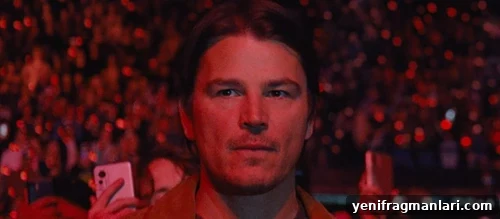
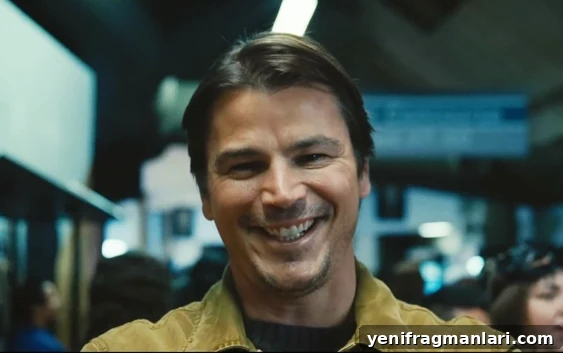
Josh Hartnett anchors the film with a magnetic lead performance. His presence is compelling from the start, and he commits to the character’s coldness and detachment in ways that initially read as stilted but ultimately reveal a purposeful choice. In the third act his performance pays off: the earlier restraint becomes a deliberate portrayal of a person alienated from normal human emotion, which deepens the unsettling quality of his role. In short, Hartnett’s work is a clear highlight and demonstrates why his return to major-studio cinema is welcome.
Visually, the film is polished. Shyamalan’s recurring technique of cutting to a first-person viewpoint is used here with increasing significance as the narrative progresses. Those subjective shots acquire meaning over time, and the concert sequences are staged to feel immersive and immediate. The production design and sound work earnestly to capture the charged energy of a live event, and Shyamalan often finds effective ways to extract suspense from visual composition and character interaction rather than relying solely on explicit violence.
Where Trap falters is in its narrative shortcuts and occasionally obvious manipulations of perspective. The movie insists on guiding our attention to particular details and questions—how will law enforcement catch the killer, or how will the killer evade capture—without fully supplying credible means or motivations. Characters sometimes act in ways that feel narratively convenient rather than organically motivated. Exposition creeps into dialogue too often, and the film occasionally restricts the audience’s viewpoint in ways that undermine immersion rather than enhance it.
These storytelling weaknesses are not fatal; the movie remains engaging and often tense. But they limit the depth of the film’s thematic ambitions. Compared to some of Shyamalan’s earlier achievements, which balanced surprise with tight logic and strong atmospheric control, Trap feels more concerned with conceit than with consistently rigorous execution. The result is a thriller that delivers entertainment and a few memorable sequences but does not fully cohere on a thematic or structural level.
The film’s score and music, including contributions by Saleka Shyamalan, help give the piece a distinct tone and may appeal to viewers who appreciate a strong sonic identity alongside thriller pacing. That musical element combined with the arena setting could attract a dedicated audience curious about the interplay between popular performance culture and true-crime tropes.
In comparison to intimate, low-budget thrillers that might mask manipulative plotting through atmosphere and constraint, Trap is a big-studio production that exposes its creative shortcuts more plainly. It is not a Hitchcockian exercise in sustained dramatic tension, nor does it reach the quieter mastery of Shyamalan’s best early films. Yet it remains watchable, anchored by a powerful lead performance and moments of effective visual suspense.
Score: 10/24
Rating: 2 out of 5.
Recommended reading: M. Night Shyamalan Directed Movies Ranked (overview of the director’s career and notable films)