
True Things (2021/22)
Director: Harry Wootliff
Screenwriters: Molly Davies, Harry Wootliff
Starring: Ruth Wilson, Tom Burke, Hayley Squires, Elizabeth Rider, Frank McCusker
Love, romance and sex are core parts of human experience, yet they carry different meanings depending on individual perspective, history and social context. In our thirties these concerns often sharpen: questions about commitment, caregiving and parenthood become more pressing and can feel suffocating—especially for women approaching forty. Harry Wootliff’s film adaptation of Deborah Kay Davies’ novel, True Things About Me, released as True Things in 2021/22, attempts an intimate exploration of these pressures. The film asks what happens when affection and desire become distorted by memory, expectation and the erosion of identity, and whether self-love can exist independent of social demand.
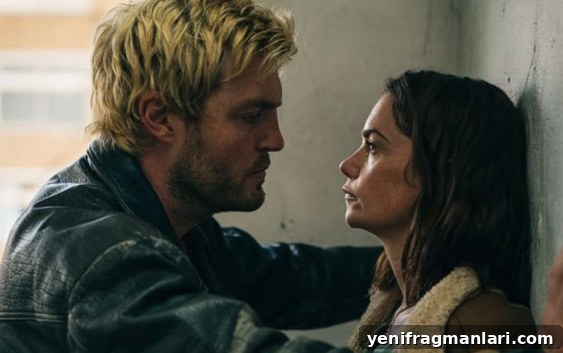
At its center are two strong performances from Ruth Wilson and Tom Burke, both of whom bring depth and texture to the film. Wilson portrays Kate, a woman quietly drifting through life, weighed down by routine, insecurity and mounting societal questions about her future. Burke plays Blond, an unpredictable, charismatic client who re-enters life like a disruptive force. Their chemistry anchors a story that mixes eroticism, power dynamics and generational anxieties, staged through a dreamlike narrative that both illuminates and confounds.
Kate is drawn into a reckless affair with Blond, who oscillates between magnetic charm and aloof danger. He asks her to do small, intimate things—drop her tights, lend her car—and these gestures quickly shift into a consuming fixation for her. Kate takes time off work and rearranges the life she once managed with careful routine. Blond, with his ex-con past and party lifestyle, occupies a mythic space for Kate: an escape, a puzzle and a mirror of his own fractured self. They are two people learning to move again after long periods of emotional exile, yet their motivations and needs rarely align.
Wootliff approaches the material with a strong surreal streak. Blond’s sudden appearances, sometimes palace-like and other times banal, are staged as if they might be figments of Kate’s imagination or harsh realities intruding on her life. Dream sequences and blurred transitions are woven tightly into Kate’s arc, but their execution often feels uneven. Rather than sharpening the film’s themes, these flights occasionally dilute focus and leave key emotional beats underdeveloped.
True Things establishes many interesting thematic threads—gendered expectation, the tension between desire and self-preservation, and the disquiet of modern relationships—but it struggles to commit to a singular vision. Scenes tease the promise of deeper insight, then pivot away, as if searching for a tone that never fully arrives. The result is a work that feels experimental yet unfinished, ambitious in idea but inconsistent in follow-through.
The film’s weaknesses are most evident in its supporting elements. Secondary characters can read as underwritten, diminishing their impact and leaving relationships that should feel lived-in instead feeling schematic. Some dialogue slips into cliché, and there are moments when technical choices—sound mixing and tonal shifts—undermine rather than enhance the emotional core. These issues interrupt immersion and make it harder to trust the film’s more enigmatic choices.
Still, True Things has significant strengths. Ruth Wilson delivers a quietly devastating performance, conveying a porous inner life with subtlety and conviction. Tom Burke embraces Blond’s dangerous allure with a physicality and charisma that persist in the memory. Composer Alex Baranowski provides an evocative score that punctuates the film’s mood, at times lifting scenes into striking emotional register.
Ultimately, the film is a study in contradictions. It aims to probe the “truths” of intimate life but often substitutes ambiguity for clarity. Wilson and Burke’s chemistry and performances justify the film’s existence and offer glimpses of what a more disciplined version might have achieved. Yet the overall impression is one of potential only partially realized: a film that raises meaningful questions about love, desire and selfhood in midlife, but stops short of offering a clear or satisfying answer.
True Things is worth seeing for the lead performances and its willingness to take formal risks. However, its thematic fragmentation and occasional technical missteps leave the viewer wondering if a more focused approach would have revealed a deeper, more resonant truth about relationships and the pressures of expectation.
10/24