
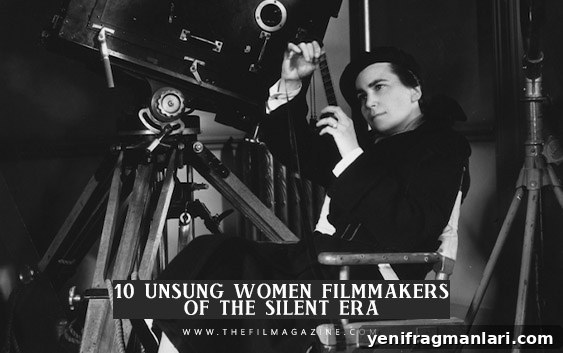
Since the silent era, women have played vital and often underrecognized roles in the development of cinema. Many women were writing, editing, directing, and producing films as early as the late 19th and early 20th centuries, and some helped pioneer filmmaking techniques still in use today. Because of sexism and racism, however, the achievements of numerous women fell into obscurity: their work was minimized, misattributed, or erased. This article seeks to restore some of that history by highlighting ten pioneering women filmmakers of the silent era whose contributions deserve wider recognition.
Follow @thefilmagazine on Twitter.
10. Eloyce Patrick King Gist

Eloyce Patrick King Gist is recognized as one of the first Black women filmmakers. Working at a time when films for Black audiences were largely underserved, Gist and her husband produced movies aimed at spiritual uplift and moral instruction rather than simple entertainment. Born in 1892 in Hitchcock, Texas, she married James Gist, an evangelical Christian who produced films for local churches. Though she was a Baha’i by faith, Eloyce collaborated closely in the production process: she rewrote, edited, and may have reshot scenes for films such as Hell Bound Train (1929–1930) and Verdict Not Guilty (1930–1933).
The Gists’ films were often unpolished compared with mainstream productions—some scenes were out of focus, and nonprofessional actors and unconventional narratives were common—but they represented independent Black filmmaking during the silent era and remain historically significant despite their aesthetic roughness.
9. Margery Wilson

Born Sara Barker Strayer, Margery Wilson changed her name to protect her family’s reputation and pursued a stage and screen career that brought her to D.W. Griffith’s Intolerance (1916). Under contract with Griffith she acted in dozens of roles. Between 1920 and 1923 she claimed to have written, produced, and directed multiple films for the New York Motion Picture Corporation, among them The Offenders (1922–1923), That Something (1920), Two of a Kind (1922), and Insinuation (1922). Unfortunately, most of those films are lost and only still photographs survive.
Scholars debate the exact extent of her directing credits—some archives credit others as directors—but contemporary accounts and Wilson’s own memoirs indicate she handled much of the behind-the-scenes production on several titles. Regardless of lingering attribution questions, Margery Wilson stands as an early female pioneer in silent-era filmmaking.
8. Dorothy Davenport Reid

Dorothy Davenport Reid was among the first women to produce and direct in Hollywood. Beginning her career as an actress in 1911, she became well known alongside her husband Wallace Reid. After his tragic decline and death from morphine addiction—one of early Hollywood’s first public scandals—she returned to film work billing herself as Mrs. Wallace Reid. Davenport Reid used cinema to address social issues such as drug abuse, domestic violence, and sex trafficking in films like Human Wreckage and The Red Kimono.
She produced numerous projects, sometimes under Thomas Ince’s oversight and later through her own Dorothy Reid Davenport Productions. Legal battles over The Red Kimono, and shifting commercial fortunes, constrained her later career; nevertheless, she directed the 1929 feature Linda, notable for its treatment of domestic violence, bigamy, and female friendship. Her work offers an early example of socially conscious filmmaking led by a woman in Hollywood.
7. Madeline Brandeis

Madeline Brandeis financed and produced films after acquiring independent wealth, launching a short but impactful career. Her first commissioned film, When East Meets West (1919), was made for the Omaha Chamber of Commerce. In Hollywood she produced and financed titles such as Not One to Spare (1924), The Shining Adventure (1925), and Young Hollywood, though few prints have survived.
Brandeis is perhaps best remembered for her educational children’s series, Children of the Lands, produced for Pathé. These one-reel travelogues—shot in Europe and the United States with local casts and crews—were designed for elementary school audiences and were praised for broadening children’s horizons. The League of Nations even recognized this work as contributing to international understanding. Brandeis later transitioned to a successful career as a children’s book author as the market for children’s literature expanded in the United States.
6. Helena Smith Dayton

Helena Smith Dayton pioneered early clay animation with her 1917 short Romeo and Juliet, making her one of the first female clay animators in film. Her approach used real doll clothing and human hair on articulated figures to suggest realistic human movement, and contemporary reviewers praised the short for its expressive handling of the play’s themes of life, love, and sorrow. Dayton’s involvement in film was brief—after completing the short she served with the YWCA in France during World War I—but her work helped establish techniques that would influence later stop-motion and model animation.
5. Elizabeth Pickett

Elizabeth Pickett was a documentarian who focused on marginalized communities in the American West. A 1918 graduate of Wellesley’s Women’s College, Pickett worked for the American Red Cross as a publicist and historian, directing commissioned publicity films before joining Fox Films from 1923 to 1926. Aware of the industry’s constraints on women, she argued that writers needed to direct their own scripts to retain control over their work.
Her Fox shorts include King of the Turf (1923), and Cliff-Dwellers of America (1925), which documented the lives of Navajo people at Mesa Verde and inspired later fictionalized films. Pickett also wrote, edited, and titled features such as The Shamrock Handicap (1926), Marriage (1927), and Fleetwing (1928), contributing substantively to both documentary and narrative filmmaking in the silent era.
4. Olga Preobrazhenskaya

Olga Preobrazhenskaya was a trailblazer in Russian and Soviet cinema. Born in Moscow in 1881, she studied at the Moscow Art Theatre under Konstantin Stanislavsky and acted in more than twenty films before directing her first feature, The Lady Peasant, in 1916. She went on to direct or co-direct works such as Victoria, Kashtanka, Prairie Station, and Peasant Women of Ryazan. The latter film stands out for its experimental cinematography and its sympathetic, proto‑feminist portrayal of peasant women; notably, it avoided heavy-handed propaganda and is now regarded as a cinematic achievement of its time.
After teaching at the All-Union State Institute of Cinematography, Preobrazhenskaya continued to direct children’s films and, despite political purges that limited her opportunities in the 1930s, she returned to co-direct Prairie Station in 1941. Rediscovery by film historians in later decades has restored her reputation as a pioneering director in early Soviet cinema.
3. Dorothy Arzner

Dorothy Arzner enjoyed a long and influential career from 1919 to 1943 and is one of the most prolific women directors of early Hollywood. Beginning as a script typist at Famous Players-Lasky (Paramount), she moved into film editing and set work under mentors who allowed her to assume greater responsibilities. She directed a number of Paramount features in the late 1920s, including Fashions for Women (1927), Get Your Man (1927), and Manhattan Cocktail (1928).
Notably, during the production of The Wild Party (1928), Arzner devised a practical solution to record sound for a moving actor by attaching a microphone to a rod and suspending it above the set—an early version of the boom microphone that remains essential in filmmaking today. After leaving Paramount she freelanced for RKO, United Artists, Columbia, and MGM, directing films such as Christopher Strong (1933) starring Katharine Hepburn and Craig’s Wife (1936) starring Rosalind Russell. Later in life she directed training films for the Women’s Army Corps, taught filmmaking, and produced commercial work, leaving a lasting legacy of technical innovation and creative leadership.
2. Lois Weber

Lois Weber was one of the most important and influential directors of the silent era, notable for both her technical experimentation and her persistent engagement with social issues. Beginning in theater, Weber moved into film and in 1907 began writing and co-directing with her husband Phillips Smalley. As the Smalleys they worked for Gaumont and later Universal, directing increasingly ambitious one- and two-reel films with a regular stock company. In 1914 Weber directed a four-reel adaptation of The Merchant of Venice—the first feature-length film directed by a woman.
Her 1915 film Hypocrites tackled organized religion and sexual hypocrisy and became controversial for featuring a full-frontal nude figure in service of allegory. Weber continued to make socially conscious films on topics such as capital punishment, drug abuse, poverty, and contraception with titles like The People vs. John Doe, Hop, the Devil’s Brew, Shoes, Where Are My Children, and The Hand That Rocks the Cradle.
In 1917 she founded Lois Weber Productions, constructing a sizable outdoor stage and studio facilities that allowed her more creative control. For a time she was among the highest-paid directors in Hollywood, experimenting with location shooting and film technique. Though her production slowed after 1922, she continued to direct films into the late 1920s and early 1930s, leaving a formidable body of work that addressed moral and social concerns rarely tackled by mainstream filmmakers of the time.
1. Alice Guy Blaché

Alice Guy Blaché is widely acknowledged as the first woman director in film history and one of the medium’s true pioneers. Born in Paris in 1873, she began working as a secretary at Gaumont when the company acquired a motion-picture camera. Selected to direct after viewing early film screenings, she created The Cabbage Fairy (1896), using photographic tricks learned from still photographers to achieve special effects. Her early work included Vie du Christ, a thirty-minute production with numerous sets and hundreds of extras—ambitious technical undertakings for the era.
After marrying cameraman Herbert Blaché, Alice headed Gaumont’s New York office and later cofounded Solax, producing films at a rapid pace. Her Solax titles included A Man’s a Man (1912), The Roads That Lead Home (1913), The Making of an American Citizen (1912), The Detective and His Dog (1912), and The Pit and the Pendulum (1913). She managed production and business affairs, became company president, and later established rival ventures. Though production slowed with World War I and personal changes, her last major film was Tarnished Reputations (1920) before she eventually returned to France.
Alice Guy Blaché’s influence has been recognized by later generations: she received honors such as the French Legion of Honor and a posthumous lifetime achievement award from the Directors Guild of America. Film historians credit her with inventing approaches to directing and production that shaped the early century’s emerging cinematic language.
Recommended for you: Ten Women Who Defined and Evolved Horror’s Final Girl Trope
Written by Cynthia Scott
You can support Cynthia Scott in the following place:
Newsletter – cynthiascott.substack