
Elvis (2022)
Director: Baz Luhrmann
Screenwriters: Baz Luhrmann, Sam Bromell, Craig Pearce, Jeremy Doner
Starring: Austin Butler, Tom Hanks, Olivia DeJonge, Helen Thomson, Richard Roxburgh, Kelvin Harrison Jr, Xavier Samuel, David Wenham, Kodi Smitt-McPhee
From the very first moments, Baz Luhrmann’s distinctive style announces itself: an embellished studio emblem, exuberant cinematography and rapid-fire editing set the tone for a biopic that is more of an audio-visual spectacle than a conventional life story. Elvis is a cinematic roar—vivid, theatrical and unapologetically heightened—capturing both the dizzying ascent of its subject and the complex, often corrosive machinery behind his fame.
Told largely through the memories of Colonel Tom Parker (Tom Hanks) as he lies on his deathbed, the film traces the partnership between Parker and Elvis Presley (Austin Butler). Their meeting marks the start of a dramatic rise to the top of popular culture, a relationship defined by explosive performances, commercial triumphs and the steady tug of control that ultimately shapes and distorts Elvis’s career.
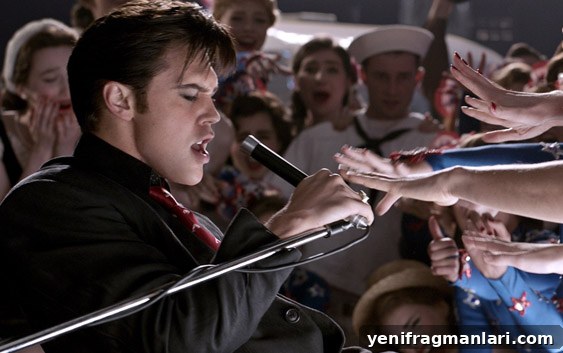
Austin Butler’s performance is the film’s emotional core. On screen he inhabits Elvis not as an impersonation based solely on looks, but through movement, voice and an electric presence that convinces. Butler captures the intoxicating charisma of early Elvis—the raw sexuality, the tremor of vulnerability and the thrilling stagecraft—while shifting into the later, more polished showman driven by spectacle. The result is immersive: close-up or in full performance, Butler convinces the audience of Presley’s magnetism and cultural power.
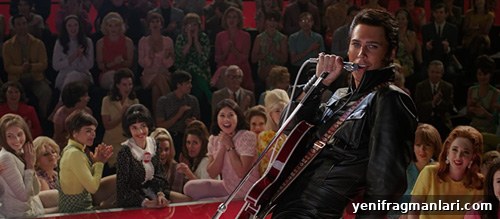
Luhrmann’s staging of musical moments avoids being staid or purely theatrical. Cinematographer Mandy Walker often places the camera amidst the action—sweeping between Elvis’s legs, darting through the crowd, and lingering on enraptured faces—so live performances feel immediate and communal rather than staged set pieces. These scenes underscore why Elvis provoked such strong reactions: he was a performer who bridged worlds and ignited audiences.
The film also foregrounds Elvis’s musical debt to African American artists. Scenes set in Memphis capture him soaking up the sounds of Beale Street, sharing space with figures who influence his style. That context is essential: Presley came of age in a cultural melting pot, and his ability to channel Black musical forms—while also being celebrated by white audiences—underlined the complicated cultural exchanges and the controversies that followed.

Tom Hanks’s Colonel Parker is played with a blend of charm and menace. Heavy prosthetics transform Hanks into a showbiz fixer whose savvy and opportunism helped fuel Elvis’s stardom. As narrator and antagonist, Parker towers large in the film’s moral universe—his small-world scheming and relentless pursuit of profit clash with Elvis’s creative impulses. At times the portrayal leans toward caricature, but that approach amplifies the power imbalance between artist and manager and highlights the exploitative aspects of fame.
The film contrasts peak moments of Elvis’s career—glittering Las Vegas performances, television comebacks, and wildly popular recordings—with the compromises behind the scenes. Much of the dramatic tension stems from Parker’s reluctance to risk profit for artistic growth: blocked tours, formulaic movie deals and commercial gimmicks repeatedly interrupt Elvis’s musical exploration. Those conflicts reveal the trade-offs that often accompany mass success and frame Elvis’s later struggles as both personal and systemic.
Supporting characters, from Elvis’s family to Priscilla (Olivia DeJonge), sometimes receive less screen time than the magnitude of their real-life roles might merit. The film favors sweeping impressions and kinetic set pieces over deeply layered portraits of every figure in Elvis’s life. Likewise, Luhrmann’s approach moves between nonlinear memories and grand set pieces; while not strictly conventional, it does return at times to familiar biopic beats, making the narrative accessible even amid stylistic excess.
If Moulin Rouge! remains Baz Luhrmann’s most celebrated work in terms of stylistic coherence, Elvis stands as his fullest expression of excess and spectacle. The film amplifies every element—music, design, performance—to create a portrait of a cultural phenomenon that feels as much myth as biography. Die-hard fans may debate specific choices or omissions, but the film effectively conveys the revolutionary pulse of Elvis Presley’s music and the scale of his cultural impact.
Ultimately, Elvis succeeds as a vibrant, sensory biography that honors its subject’s energy while interrogating the machinery of fame. It delivers powerful musical set pieces, a committed lead performance and a clear-eyed, if stylized, critique of the relationship between artist and manager. For viewers seeking a bold, cinema-forward retelling of one of America’s most influential entertainers, Luhrmann’s film offers a compelling, frequently electrifying experience.
Score: 19/24